
Friday, January 30, 2026
Friday of the Third Week in Ordinary Time
My sisters and brothers in the Lord,
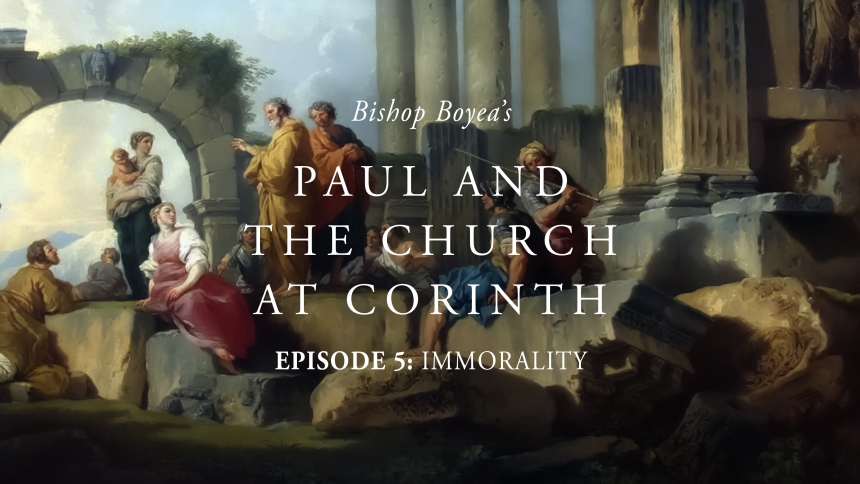
In this fifth presentation, we move on to chapters five and six of I Corinthians. The challenges that Paul faced in evangelizing and then shepherding this community are similar to those we face today. Hence, we can learn many lessons from this fascinating episode in early Christian history.
Episode 5: Immorality (I Corinthians 5-6)
Paul believed that he may have been interpreted as tougher than he intended in his first correspondence. He really did not want the Corinthians to separate themselves from their environment. It is also clear that he did not want the environment to infect the community. These two chapters really speak quite eloquently to our own situation today as well, how to live as Christians in a non-Christian setting.
Paul begins not only by excommunicating a member of the community who was living with his father’s wife, presumably a step-mother, but he also berates the community for approving of this. Paul then approaches the matter almost as a legal course of action. He says he has pronounced judgement and it now up to the people themselves to deliver this man over to Satan in order to save his spirit. Here Paul contrasts flesh, which will be purged by Satan, with spirit, terms he is using to indicate the direction of one’s life. He does not mean to separate body and soul as this becomes clear a few verses later.
Then Paul addresses the fact that this is really about what the community as a whole is to be. Will it be the temple of the Spirit and the body of Christ or will it just be like the pagans? Here Paul lists 10 vices which, while certainly not a complete list, must have typified the environment of the area and perhaps some of the members of the Christian community as well. These are sexual immorality, avariciousness, greed, idolatry (5:10), slander, drunkenness (5:11), adultery, passive homosexuality (probably with young boys), aggressive homosexuality (with adults), and thieves (6:9-10). Imagine having to live a Christian life completely surrounded by these behaviors.
Perhaps, as we hear in the middle of chapter six, there were folks in the community who played the line that everything is lawful, perhaps relying on what Paul must have taught them, that in Jesus we are free. Paul will have none of this misunderstanding. Our freedom is to belong to Christ. The broader society may disparage the human body and say that it is unimportant. Or that it is something simply to be indulged. But Paul reminds them that we have been purchased, not just as souls, but as embodied souls, and thus we belong to God. “Therefore, glorify God in your body” (6:20). This unity of body and soul was something unique in the Judeo-Christian heritage and could be a tough sell to the culture of that time.
Just as Paul had demonstrated how to deal with the man at the beginning of chapter five, now he wants the community itself to learn how to handle difficulties internally rather than going to public court for settlements. His aim again is to reinforce the nature that we are not only members of the body of Christ as individuals but as a Christian community. That is why the image of the leaven is so helpful for Paul’s presentation. The community as a whole is called to be holy even as each individual is. It would be better to suffer injustice from a brother than to try to exact judgment against him. Then, as this united leaven, we can alter the course of the broader world.
Until next week, may God bless you,
+ Earl Boyea
Bishop of Lansing
P.S. Here is a video version of this week's talk. Please do share with friends and family. Thank you.