
Friday, January 23, 2026
Feast of Saint Marianne Cope
My sisters and brothers in the Lord,
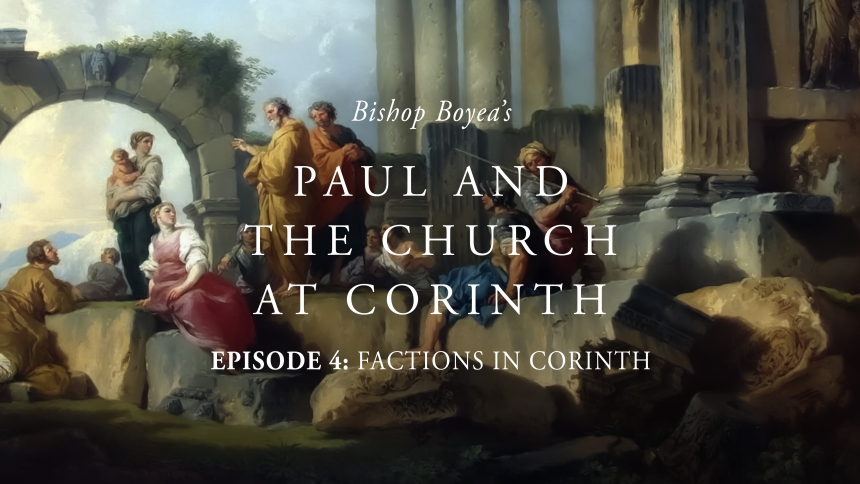
Welcome to the fourth installment of my exploration of Saint Paul's engagement with the Church in the city of Corinth in southern Greece. The challenges that Paul faced in evangelizing and then shepherding this community are similar to those we face today. Hence, we can learn many lessons from this fascinating episode in early Christian history.
Episode 4: Factions in Corinth (I Corinthians 1-4)
As we now begin to examine I Corinthians, let us today focus on chapters one through four. It seems that it was not only Apollos’ ministry which led to discord in the Corinthian community. Paul also speaks of Cephas (I Cor 1:12). Whether it had happened that Peter actually stopped here or whether some of the Christian community merely looked to him as an alternative to Paul is unknown. Perhaps, other Christian missionaries from the Holy Land had come to Corinth and touted their connection to Peter. Or, perhaps, visitors who claimed to follow Christ may well have included Christians who simply refused to follow any human preachers.
As noted above, Paul had received a letter from Corinth (I Cor 7:1) which also contained a number of questions, to which most of I Corinthians is dedicated. Nonetheless, he also includes his response to the divisiveness present as reported by Chloe’s people. And presumably a more moderate picture was presented by Stephanas, Fortunatus, and Achaicus, since they refreshed Paul’s spirit (I Cor 16:17-18). In fact, they may have been the ones to carry the questions mentioned in I Cor 7:1. It seems then that Paul’s second piece of correspondence dates from around the end of 54 AD and this is what we find in our I Corinthians.
There are two terms which occur frequently in this letter which really capture Paul’s intent. The first one is adelphoi, “brothers,” which is usually translated today as “brothers and sisters.” This occurs in this letter more than any of his other letters (21 times). He really wants the Corinthians to know that not only is he their brother, but that the aim of Christian life, especially in this divided community, is to be brothers and sisters. The second term is Jesus, which occurs eight times in the first nine verses. This text is not to build up or tear down Paul or Apollos or any group in the Church at Corinth, but rather to focus on the real center of everything, Jesus Christ.
In these first four chapters Chloe’s concern about the internal division in the community is something Paul needs to nip in the bud. It is not always clear what might be the basis of these divisions. Are there really groupies or cliques claiming to follow Paul or Apollos or Cephas or Jesus? Or do these names come up merely to disguise some deeper divisions regarding theology? Paul does speak about the wisdom of this world versus the wisdom of God. It could be that Apollos, unintentionally of course, came across as proposing a more philosophical approach to faith, whereas Paul preached Christ and him crucified and with the power of the Holy Spirit. Paul’s approach was probably more pastoral and practical and less systematic than Apollos. Paul will claim that he delivered a simplified Gospel message because of the immaturity in faith of his audience. The various means of evangelizing may have appealed to different groups, perhaps the more educated liking Apollos’s more philosophical approach. Perhaps as well, whoever baptized any given individual may have seen him or herself as tied to that person (1:13-14). In any case, Paul wants to make it clear that all that has happened to the Corinthians is the work of God in Christ Jesus and not the work of any individual human being.
Now having said this, it is also clear that Paul wants to be recognized as the founder, the father, of this community of Christians. He therefore has the authority to address them and indeed to correct them, something he will do in the rest of this letter. He emphasizes that Christ is the key and that whoever is preaching and teaching in Corinth is a servant of Christ. Christ it is, in the Holy Spirit, who has built that community into the Temple.
In chapter four Paul notes that the Corinthians should imitate him. No doubt he wants them to see him as living a life in Christ and that is why he will send Timothy to them who will testify to this fact.
Finally, it seems that pride or boasting is also a factor in the divisions. Perhaps this was due to some level of social stratification. There is no indication about the social status of the Corinthian Christians. No doubt they included low born, perhaps even slaves. There must also have been some leaders, people like Prisca and Aquila, Chloe, Stephanas, Crispus, Gaius, Erastus (Romans 16:23), and Phoebe (Romans 16:1-2). Were these some of the real leaders and were people flocking to such individuals? They all seem to be friends of Paul, so this is doubtful, but perhaps there were others.
Until next week, may God bless you.
+ Earl Boyea
Bishop of Lansing
P.S. Here is a video version of this week's talk. Please do share with friends and family. Thank you.