
Friday, March 13, 2026
Friday of the Third Week of Lent
Dear Sisters and Brothers in Christ,
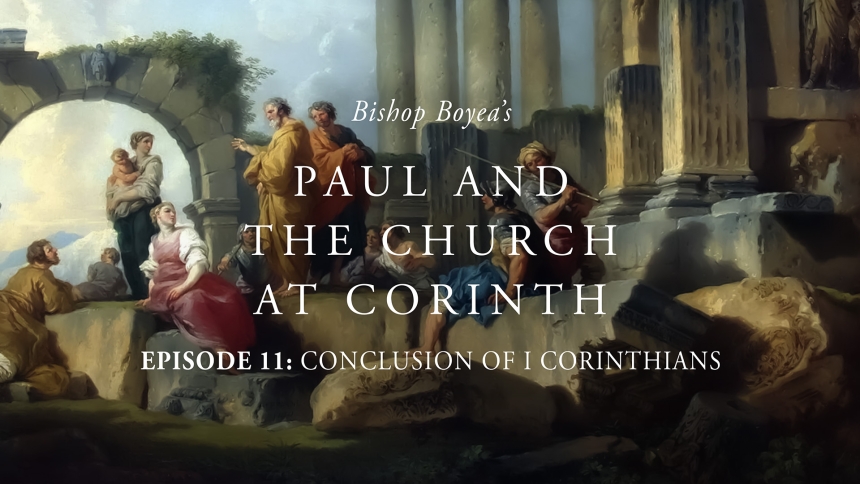
In this eleventh presentation on Saint Paul and the early Church in Corinth, we discuss the conclusion to First Corinthians. This last chapter, chapter sixteen, deals with something with which we are all familiar, the Sunday collection, something Paul here calls a charisma, a gift.
Episode 11: Conclusion of I Corinthians (Chapter 16)
Paul did not want his folks to see this as a duty or penalty, but rather as a free will offering, as a sharing in God’s bounty. Paul had made a promise when last in Jerusalem to provide some solace for the Jewish-Christian community in the Holy Land: “Only, we were to be mindful of the poor, which is the very thing I was eager to do” (Galatians 2:10). Here and in his Second Letter to the Corinthians, as well as his letter to the Romans, he mentions this collection for the poor back in the Jerusalem Church (see Acts 11:27-30; 24:17). He wants to make sure they have their own designated money carriers so that it is not all dependent on him, probably so he couldn’t be blamed for mishandling such a collection! This collection is a way to demonstrate the unity of the Church, something that has been the issue of this entire letter. Paul wants divisions to cease.
Paul then notes that it is his intention to travel from Ephesus across the sea to Macedonia and then down to Corinth. We find out in II Corinthians that this trip was postponed. Nonetheless, his disciple, Timothy, may visit Corinth and if he does, the Corinthian Christians should treat him with respect. We know that Timothy was not a strong character, but Paul trusts him completely. Then Paul makes mention of Apollos whom Paul had urged to return to Corinth. Apollos chose not to perhaps because he feared he would only aggravate the divisions in that community. Paul gives no indication here that there is any division between him and Apollos.
Paul also commends the Corinthian messengers who came to see him, Stephanas, “the first fruits of Achaia,” who must have been among Paul’s first converts in Corinth, along with Fortunatus and Achaicus. Paul wants the folks in Corinth to see in them leaders. Perhaps Stephanas’ leadership had been challenged in Corinth and now Paul is clearly supporting him.
Finally, Paul extends greetings from others, including Prisca and Aquila, who had been exiled from Rome and who had welcomed Paul at Corinth and who now were in Ephesus with a Christian community meeting in their home. Perhaps Paul too was staying with them.
Paul then concludes with his own signature to a letter that was most likely written by a scribe, who was probably Sosthenes (I Corinthians 1:1) who was with him. Paul then wrote a word of anathema, a condemnation, for any who did not love Jesus, to whom he then called out in prayer, Marana tha (Come, Lord [Jesus]).
In this entire letter, Paul has not been so much writing a theological treatise as deriving from his theology practical solutions to questions and problems being posed in Corinth. Thus, the strong statements about unity and the cross of Christ and his Resurrection and the role of the Spirit are all meant to restore the Corinthian community to the united Church which Paul had founded.
It appears that Paul made a quick but “sorrowful” visit to Corinth (II Corinthians 2:1) after a rather concerning report from Timothy’s visit there in early 55 AD. It seems that this was a tough and challenging visit for him. As a result, he wrote his “tearful letter,” which we will examine as II Corinthians 10-13, probably later that same year of 55 AD. This letter may have been carried to Corinth by Titus (II Corinthians 8:6).
However, by that fall, Titus, who had been sent ahead to Corinth, reported to Paul in Macedonia that things were much better. This occasioned the writing of II Corinthians 1-9 probably in late 55 or early 56 AD. Finally, later in 56 or early 57 AD, Paul most likely returned to Corinth (see Acts 20:1-3) on his way to Jerusalem where he would meet his arrest and eventual conveyance to Rome.
Until next week, may God bless you.
+ Earl Boyea
Bishop of Lansing
P.S. Here is a video version of this week's talk. Please do share with friends and family. Thank you.