
Friday, January 9, 2026
Feast of Blessed Pauline-Marie Jaricot
My sisters and brothers in the Lord,
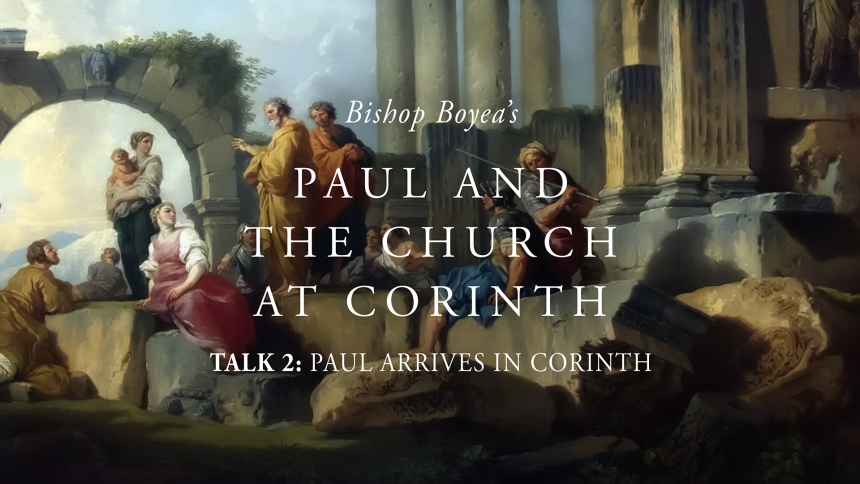
Welcome to this second episode in our exploration of Saint Paul’s mission in Corinth. I hope you enjoyed our first installment last week. Today Paul arrives in Corinth.
Episode #2: Paul arrives in Corinth
There are two sources for our knowledge of Paul’s ministry in Corinth: the Acts of the Apostles, chapter 18, and his own letters. According to the Acts, Paul left Athens after a so-so ministry there and then traveled south by means of the isthmus arriving in Corinth. He met Aquila and his wife, Priscilla (Paul calls her Prisca), who had fled Rome at the ousting of the Jews by the Emperor Claudius in 49 AD.
Paul seems to have supported himself by joining this couple in their work as tentmakers. On Sabbaths, he sought to convince Jews and God-fearers about Jesus. We are then told that Silas and Timothy finally made their way down from Philippi and Thessalonica, from whence Paul had been expelled. They brought significant financial support from that area such that Paul was now freer to exercise his ministry.
Rejected then by the Jews, Paul moved his ministry to the home of a God-fearer, Titus Justus, who happened to live next door to the Synagogue. He was even able to bring over the Synagogue official Crispus and his family as well a number of new converts, whom he baptized (Acts 18:8). Acts notes: “One night in a vision the Lord said to Paul, ‘Do not be afraid. Go on speaking, and do not be silent, for I am with you, no one will attack and harm you, for I have many people in this city.’ He settled there for a year and a half and taught the word of God among them” (18:10-11). It is possible that this vibrant Christian community never exceeded 200 people during Paul’s time.
The Jewish community was not content with him causing discord next door and so brought him up on charges before Gallio, the proconsul of Achaia, in about 51 AD, who dismissed the case as a matter of purely internal Jewish concern. We hear little more about his stay in Corinth until he leaves for Ephesus with Prisca and Aquila, departing from the port of Cenchrae, where Paul made some kind of vow and cut his hair. He then left his friends in Ephesus and made his way to Syria, from whence his various missionary journeys had always begun.
It is at this point that we can take a very large-picture view of the Corinthian correspondence. While we have only two letters, Paul makes mention of more than two. It is possible that they have all been melded together in the current documents. Obviously, this is a process of educated guessing, but some scholars have come up with the following arrangement:
A first letter was described by Paul: “I wrote to you in my letter not to associate with immoral people….” (I Cor 5:9). Paul’s letter must have been received as too absolute a statement, since Paul later noticed that the recipients were taking it to mean that the Christians “would then have to leave the world” (5:10). Paul rather meant that the Christians were to preserve their own community from immorality, not to separate from the larger Corinthian community, which, in fact, they should be evangelizing. It is possible that II Corinthians 6:14-7:1 could be that first letter. Now, just to be clear, there are not many scholars who will maintain this position, but I like to think that it fits the bill.
After this, Chloe’s house sent further news: “For it has been reported to me, my brothers, by Chloe’s people, that there are rivalries among you” (I Cor 1:11). In addition, at some point in Paul’s process of writing, delegates arrived from Corinth: Stephanas, Fortunatus, and Achaicus with added information (I Cor 16:17). As a result, Paul sent Timothy from Ephesus with his second correspondence which we today call First Corinthians (I Cor 4:17).
Then Paul seems to have made a “painful” visit to Corinth (cf., II Cor 2:1). The result of this “second visit” led to a “severe letter,” (see II Cor 2:4; 7:8), Paul’s third correspondence with Corinth. This is most likely our current II Corinthians 10-13. This seemingly was carried to Corinth by Titus (II Cor 2:13; 7:13). Paul seems to have been worried about how this letter was received and so made his way to Macedonia and there received good news from Titus about the Church in Corinth (II Cor 2:13; 7:5, 13).
Paul then talks about a third visit to Corinth (II Cor 12:14; 13:1, 2). As a result, Paul then sent his fourth correspondence which was very positive, promoting reconciliation and which we find generally at II Corinthians 1-9.
So, over the next weeks, allow me to present these “four” pieces of correspondence.
Until next week, may God bless you.
+ Earl Boyea
Bishop of Lansing
P.S. Here is a video version of this week's talk. Please do share with friends and family. Thank you.