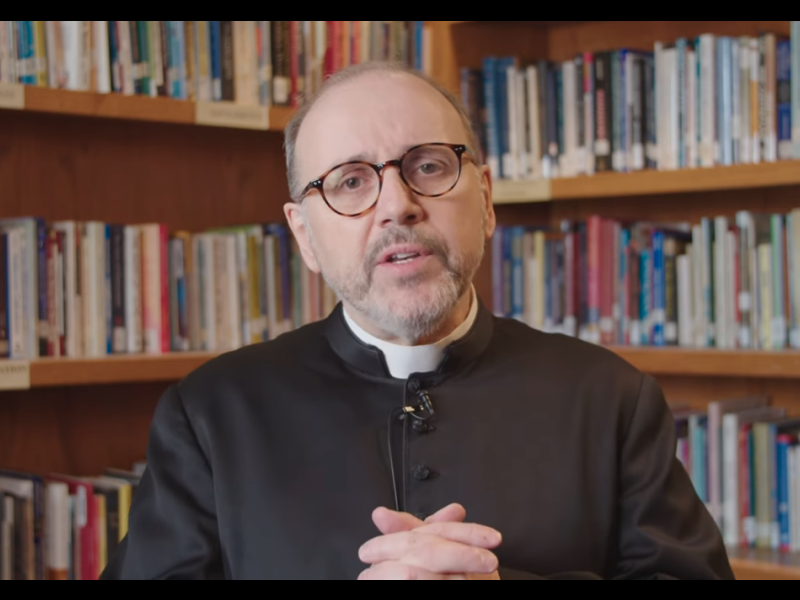
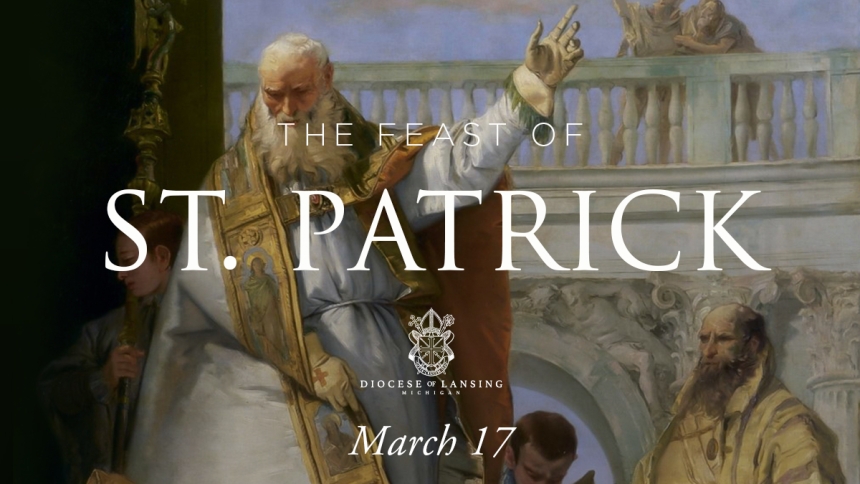
Saint Patrick of Ireland is almost unrecognizable in his modern incarnation as the reason for green beer, corn beef and cabbage and as the one who is best known for casting the snakes out of Ireland, writes Father James Conlon, pictured below, pastor of Saint Francis of Assisi in Ann Arbor and a native of County Sligo in Ireland. Like many early saints exact details of his life are scant, so we rely on his own few written words, tradition and legends to give us a fuller account of the bishop who changed not just the heart of the Irish people but as many would argue the face of the universal Church. As primary patron credited with converting the Irish to Christianity his feast day of March 17 is a solemnity and holy day of obligation in Ireland, but here in the USA it is an optional memorial, despite the enormous contribution of the Irish and its clergy and religious to the American Church. While the story of Patrick’s life is well known, it is always useful to recall a few of its important moments.
Patrick was born sometime around 385 A.D. into a Christian family in post-Roman Britain, probably somewhere in modern Wales. His father, Calpurnius, a deacon, was a local official and a man of great influence and authority. According to Patrick’s own Confession at the age of 16 he was kidnapped by Irish raiders known as the Dal Riata and sold to a farmer who put his minding sheep on Sliabh Mish in the modern county of Antrim. These were miserable years for the young man who was used to a life of comfort. But they were also years in which he turned with fervor to his Christian faith and strengthened his relationship with God through prayer. Although baptized, Patrick had until then taken his faith for granted, now it became a source of much comfort and hope as he experienced long periods of hunger and isolation.
After six bleak years as a herdsman, Patrick had a dream that the ship in which he was escape was ready to depart and so fleeing his enslaver, he made his way to the coast and returned home to his family and his former way of life. By then he had decided that priest hood was his vocation and so was ordained in Auxerre in France around the year 420 A.D.
One might have thought that six years of forced labor in a land known to the Romans as the Hibernia - the land of winter, would have soured the young man against those who had enslaved him- but not so! In one of the best-known passages of his Confession, Patrick tells of another dream in which he received a letter entitled “the Voice of the Irish” beseeching him to “walk once more among them.” By then Patrick was a bishop and so answering the call, he set out as a missionary, determined to bring the Christianity to the very people who had once enslaved him.
Despite some personal reservations about his own fitness for the task, Patrick landed back in Ireland around the year 432 A.D. and for the next 30 years toiled with heart and soul to share Christ and the gospel with the Irish people. At that time Ireland was made up of independent tribes or clans, so Patrick always had to be careful in his dealings and actions. He lived in constant danger of martyrdom as he faced the opposition and influence of pagan druids and other powerful individuals invested in maintaining the religious status quo and defending a native religion. It is said that in lighting the Easter fire on the Hill of Slane in contravention of a royal edict, he provoked the ire of the High King and his druids who were said to have warned that “if that fire is not put out tonight, it will never be put out.” How right those druids were for within two generations, Ireland was Christian and the old religion was almost erased from the land.
Equipped with a broad knowledge of the old Celtic pagan religion, the local language and its tribal ways, Patrick crisscrossed the island proclaiming the Gospel with courage and humility, baptizing thousands and establishing Christian communities and settlements and connecting with existing communities founded by others who had come before him with the gospel. Tradition tells us that he used the shamrock to explain the Holy Trinity, while also taking over many pagan sites to Christianize them. In fact, it is true to say that courage and humility were two of Patrick’s greatest gifts- as one historian once remarked “the moral and spiritual greatness of the saint shines through every stumbling sentence of his rustic Latin.”
In those 30 years Patrick changed the face of the Irish spiritual landscape. Even today the impact of his presence can still be seen in the structures and faith of the Irish people from its holy wells where Patrick is said to have celebrated baptisms to it ancient monastic ruins that still pepper the land. Indeed, of the 26 dioceses on the island of Ireland many owe their initial existence to a settlement founded by Patrick, including the primatial See of Armagh, which Patrick is said to have established around the year 445 A.D. on a parcel of land donated by a local chieftain and where he held the first synod three years later. (Incidentally, my own home Diocese of Elphin is one of those dioceses, having been established by Patrick as a Christian settlement in 435 A.D. with his disciple Saint Asicus as it first abbot)
Patrick died on March 17 about the year 461/62 A.D. leaving behind the rewards of a life spent in service of Christ and the Gospel. He was buried in Downpatrick, and in time would be joined by two other great Irish saints- Saints Brigid and Colmcille.
So, what can we today learn from this great saint?
In an era when the Church has sought to recover a greater commitment to evangelization, Saint Patrick stands out as one of the great evangelists of the western Church. In his Confession he reveals his great love of and commitment to Christ. His whole life was committed to Christ and the Church, no matter what the struggle or trial, Patrick placed his trust in Christ. His was a life rich in prayer, self-denial and fasting - something that makes his feast day in Lent all the more appropriate. While our modern celebrations of Patrick have been somewhat hijacked by the secular world, we should never lose sight of the debt that we owe Saint Patrick. Whatever our celebrations they should be about expressing our gratitude for his mission and to see in him a life that encourages faith, perseverance and obedience to God and the courage to follow one’s true calling in life.
Aside from this, Saint Patrick’s legacy is sustained by his famous prayer of protection or breastplate. While it is long, it is truly full of encouragement for all who seek to follow Christ:
Christ with me, Christ before me, Christ behind me,
Christ in me, Christ beneath me, Christ above me,
Christ on my right, Christ on my left,
Christ when I lie down, Christ when I sit down,
Christ in the heart of every man who thinks of me,
Christ in the mouth of every man who speaks of me,
Christ in the eye that sees me,
Christ in the ear that hears me.
Beannachtai na feile Padraig libh go leir!