
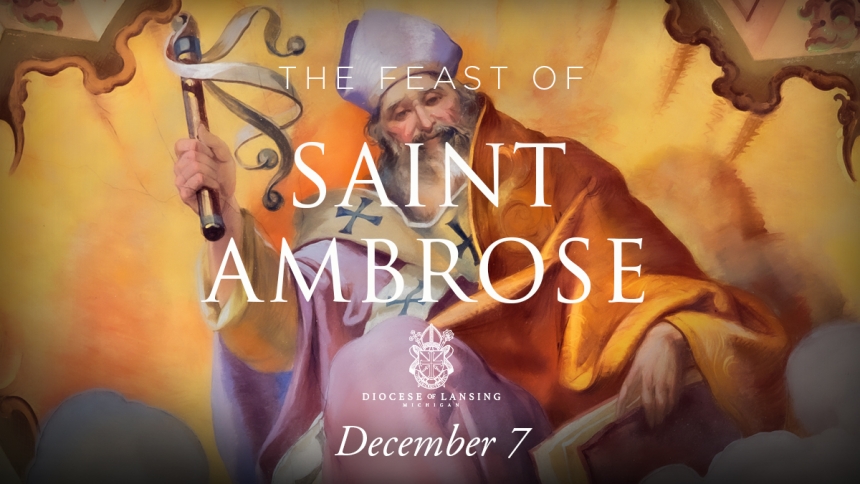
Although superseded liturgically by the Second Sunday of Advent, December 7 is still the Feast of Saint Ambrose, the great 4th century bishop of Milan in Italy who hugely influenced Saint Augustine of Hippo's decision to be baptized a Catholic. The Editor of the Diocese of Lansing's FAITH Magazine, Sean O'Neill, says he will definitely be celebrating this Sunday. Why? Sean explains:
I have two connections to this remarkable saint. First, his feast day falls on my birthday (that’s a heavy hint, by the way). The second is that, from 2001 to 2003, I worked in Milan, Italy, where Ambrose had been bishop back in the day. These connections may seem tenuous, but all my life I have been intrigued by Ambrose and his life and writings.
There is a story about Ambrose that, when he was an infant lying in his crib, a swarm of bees alighted on his face. When they were shooed away, they left behind a drop of honey. Ambrose’s father took this as a prophetic sign that he would be a great, honey-tongued orator when he grew up.
Ambrose was a staunch opponent of Arianism, a doctrine that was popular with an estimated 80 percent of Catholic bishops at the time. Arianism maintained that God the Father was the only true God and that Jesus was merely a creature, albeit a perfect one.
In 374AD the Arian bishop of Milan, Auxentius, died, and the Arians pressed forward their claim to the succession. Ambrose hastened to the church where the election was taking place, in order to quell the mayhem that was just about to erupt. His honey-tongued words were drowned out by the chant, “Ambrose for bishop!”
Rather flattering considering that he was not even baptized at the time and knew next to nothing about theology! A few days later, he was baptized, ordained, and raised to the episcopacy to the See of Milan. Ambrose was so influential in his day that he became the major catalyst in Saint Augustine’s conversion from a life of debauchery to Christianity.
But, apart from admiring his persuasiveness, what can we possibly learn from Saint Ambrose who lived and died in a foreign land so many centuries ago? Well, one thing that he was adamant about was the truth. And he wasn’t afraid to defend it. In our modern culture, truth is under threat: truth about the human person, about the value of life, and the sovereignty of God. Are we ready to uphold these truths, or do we back down and remain silent in the face of the enemy’s lies?
There is no doubt that we should stand up for the truth. Yet there can be no Christian truth without love. Can we, like Ambrose, love even those whose anti-Christian views we utterly reject. Ambrose was so popular during his lifetime because that is exactly what he did. He loved his enemies. He was kind to his opponents. He was a shining example of the Christian ideal of loving the sinner but hating the sin.
Let’s follow his example and do the same. Let’s be unabashed in upholding the glorious truth of the dignity of the human person. And let’s put Jesus’ words into practice when he said, “Love your enemies, bless those who curse you, do good to those who hate you, and pray for those who spitefully use you and persecute you.” (Matthew 5:44). Saint Ambrose, pray for us.
